

Table of Contents

Stefan Barbieri: Four Decades of Color Measurement Innovation and What Comes Next

Interview with Stefan Barbieri

For more than four decades, BARBIERI has been developing color measurement technology for professional digital printing. CEO Stefan Barbieri talks about how color measurement is changing, why spectral data is becoming increasingly important, and how automation, software and Artificial Intelligence could shape the next generation of color quality assurance. He also discusses BARBIERI’s evolution, the company’s new leadership structure and where he sees the greatest opportunities for the years ahead.

Stefan, BARBIERI electronics has been working with color measurement technology for more than four decades. What has changed most during that time?

When we started, color measurement was essentially a specialized task performed by experts using dedicated instruments. But if we look at the development of color measurement more broadly, there has been a fundamental evolution in what we measure and what we can do with the resulting data.

The journey started with densitometers, which measure optical density and were primarily used to control the amount of ink applied during the printing process. Colorimeters represented the next step, using three filters to approximate the way the human eye perceives color.

Today, spectrophotometers measure the spectral characteristics of color. This provides a much richer and more objective description of color and creates the foundation for matching and communicating color across different printing technologies, materials and production environments.

At the same time, the role of the measurement instrument itself is changing. Color measurement is increasingly connected to software, production systems, automation and quality assurance. Instead of measuring only to create a profile or solve a color problem, measurement data can become part of a continuous process that helps monitor and control production.

For BARBIERI, this development is particularly interesting because we have always focused on challenging applications in professional digital printing. Our task is not simply to measure color, but to provide reliable spectral data under real production conditions and make these data useful throughout the digital production workflow.

BARBIERI recently expanded its leadership structure. What was behind that decision?

BARBIERI has reached a point where we want to prepare the company for its next phase.

In 2026, Viktor Lazzeri joined the management team as COO and Co-Managing Director. Viktor has already been with BARBIERI for many years and has contributed to the development of different areas of the company. During this time, he has gained experience across many aspects of our business and has developed a very good understanding of our products, processes, customers and organization.

For us, expanding his responsibility was therefore a logical step. He knows the company very well and was well prepared to take on this broader management role.

Together with my brother Markus and myself, this gives us a stronger and broader leadership structure. Markus brings his technological and financial perspective, Viktor focuses particularly on operations and organizational development, while I continue to concentrate strongly on strategy, markets, customers, partnerships and the future positioning of BARBIERI.

At the same time, our idea of growth is not primarily measured by the number of employees. We want BARBIERI to remain a lean organization with short decision making processes and the ability to react quickly.

For specialized knowledge and additional capabilities, we increasingly work with networks, technology partners, international collaborators and specialized suppliers. We believe that a relatively small technology company can achieve a great deal by combining strong internal expertise with the right external competencies.

The objective of the new leadership structure is therefore not simply to distribute responsibilities. It is to make the organization stronger, maintain our ability to make decisions quickly and create a structure that supports the sustainable development of BARBIERI over the coming years.

Does this also change your personal role at BARBIERI?

Yes, gradually.

As an entrepreneur, it is very easy to remain involved in almost every operational decision. But at a certain point, that can also limit the organization.

My role needs to move increasingly toward strategy, technology trends, customers, partnerships and identifying where BARBIERI should be in five or ten years.

Having a stronger management team gives me more opportunity to work on these questions.

Looking ahead, where do you want BARBIERI to be in the next five to ten years?

I want BARBIERI to remain what has made us successful: a highly specialized technology company that understands professional color measurement extremely well.

At the same time, we need to evolve.

I see a future in which measurement instruments, spectral data, software and automated production processes are much more closely connected than they are today.

Our opportunity is to provide not only excellent measurement instruments, but reliable color intelligence that can become part of increasingly automated production environments.

We also want to remain independent, innovative and close to our customers. Being a relatively small technology company allows us to move quickly, collaborate with specialized partners and address applications that larger companies may not consider attractive enough.

Why are spectral data becoming increasingly important?

Spectral data contain much more information than a single set of colorimetric values.

If you only look at calculated color values, you are looking at one interpretation of a measurement under defined conditions. The spectral measurement itself preserves the underlying information and therefore provides much greater flexibility for further analysis.

This becomes increasingly valuable when measurement data are used by different software systems, when viewing conditions need to be evaluated, or when data are analyzed automatically.

I believe spectral data will become even more important as production systems become more connected and intelligent. Good decisions depend on good data, and this is also true for Artificial Intelligence.

What role will automation play in professional color measurement?

Automation is one of the major developments we see.

Today, a skilled operator often decides when to measure, what to measure and how to react to the result. In increasingly automated production environments, some of these decisions can become part of the workflow itself.

This means that measurement technology needs to become easier to integrate into production processes. Instruments, software and production systems need to communicate with each other.

The objective is not automation for its own sake. The objective is consistent color quality with less manual intervention and faster feedback.

For BARBIERI, this creates opportunities to move color measurement closer to the actual production process.

Does that change the role of quality assurance?

Yes. Traditionally, quality assurance often happens after something has been produced.

The more interesting direction is to use measurement data earlier and more continuously so that deviations can be detected before they become expensive problems.

This changes color measurement from a verification tool into an active part of process control.

For customers, that can mean more consistent quality, less waste and better reproducibility across different machines, materials and production locations.

BARBIERI has a particularly strong position in large format and textile printing. Why are these applications challenging?

Because real materials are not always flat, homogeneous and easy to measure.

Textiles are a good example. Their structure, surface characteristics and handling can make reliable measurement considerably more difficult than measurement on conventional paper.

The same applies to many materials used in large format and industrial digital printing.

Our philosophy has therefore always been to develop measurement solutions for the actual substrate rather than expecting the substrate to behave ideally for the instrument.

That experience with challenging materials is an important part of BARBIERI’s know how.

Where do you see the development of color measurement in textile printing?

Textile printing is becoming more digital and more industrial.

As production volumes increase and workflows become more automated, objective quality control becomes increasingly important.

At the same time, textiles remain difficult substrates to measure reliably. This combination makes the market particularly interesting for us.

I expect measurement to become more closely integrated into textile production workflows, with spectral data being used not only for profiling but increasingly for ongoing quality assurance and process optimization.

What about packaging?

Packaging is another interesting area because color consistency is extremely important for brands.

Production is also becoming more diversified. Different printing technologies, substrates, production sites and shorter production runs create additional complexity.

Reliable spectral measurement can provide a common reference across these environments.

For BARBIERI, the interesting question is where our expertise in measuring difficult substrates and professional digital printing can create additional value as packaging production becomes increasingly digital.

How important will software integration become?

Very important.

A measurement instrument should no longer be considered an isolated device.

The value of measurement increases when reliable spectral data can flow easily into the customer’s workflow and into other software and production systems.

That means interfaces, connectivity and software integration will become increasingly important alongside the measurement technology itself.

We therefore need to think not only about the instrument, but about how our technology becomes part of a larger digital ecosystem.

Artificial Intelligence is currently discussed everywhere. Where do you see its real relevance for color measurement?

Artificial Intelligence is only useful if it solves a real problem.

For color measurement, I see interesting possibilities because we are dealing with large amounts of structured measurement and production data.

AI could potentially help identify patterns, recognize deviations, support predictive quality control or assist operators in making better decisions.

But there is an important prerequisite: the quality of the underlying data.

An AI system cannot compensate for unreliable measurement data. In that sense, accurate spectral measurement becomes even more important in an AI driven environment.

Your involvement with Covision Lab gives you another perspective on Artificial Intelligence.

Yes. BARBIERI is one of the founding companies of Covision Lab, and I have served on its Board of Directors since 2019.

Covision Lab brings industrial companies and research together around Computer Vision and Artificial Intelligence. For me, this is particularly valuable because it exposes us to developments outside our traditional field of color measurement.

The interesting part is the transfer from research into industrial applications. New technology becomes relevant for an SME when it can solve real problems and eventually create value for customers.

The Covision ecosystem has also demonstrated that research can lead to completely new entrepreneurial activities, including Deep Tech companies such as ALLSIDES, formerly Covision Media.

This experience has reinforced my belief that companies like BARBIERI need to remain closely connected to research and emerging technologies.

Does Artificial Intelligence mean that BARBIERI will become an AI company?

No. I would not describe BARBIERI as an AI company.

Our core competence is professional color measurement.

But Artificial Intelligence, Computer Vision, robotics, automation and advanced software can become technologies that complement this competence.

The important question for us is always: can a technology make color measurement more useful, more automated, more reliable or easier to integrate into our customers’ processes?
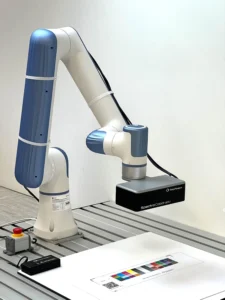
With technologies such as robotics, Computer Vision and AI, we see the possibility of bringing automated color measurement exactly to the point in a production process where measurement information is needed. Instead of bringing the sample to the measurement instrument, the measurement technology can increasingly become part of the automated process itself.

This opens up interesting possibilities for quality control and process automation, particularly in industrial production environments where materials, objects or production conditions make conventional measurement workflows difficult.

If a technology helps us achieve this, we should understand it and evaluate how we can use it.

What will remain unchanged?

The importance of reliable measurement.

Technologies change. Software changes. Artificial Intelligence will change many processes.

But if the underlying measurement is wrong, everything built on top of it is also wrong.

That is why our fundamental promise remains very simple:


When color quality counts, measurement quality counts.


Share article on

Color Blog

Read more Articels

All in Print China

ALL-in-Print 2026

Interview with Stefan Barbieri

Stefan Barbieri: Four Decades of Color Measurement Innovation and What Comes Next

Printing United Expo 2026

Scroll to Top
Cookie Consent with Real Cookie Banner